


Second-Generation Geothermal Innovation at City of Joondalup’s Craigie Leisure Centre Recognised
Oceanis International has been named a Finalist in the Superior Sustainability category of the Consult Australia Awards for Excellence, recognising its second-generation geothermal design at the City of Joondalup’s Craigie Leisure Centre.
The recognition highlights an award-winning approach to renewable energy pool heating that addresses a growing challenge facing public aquatic facilities across Western Australia: ageing geothermal systems experiencing reduced heating capacity, rising operating costs, and increasing reliance on backup heating as original performance declines.
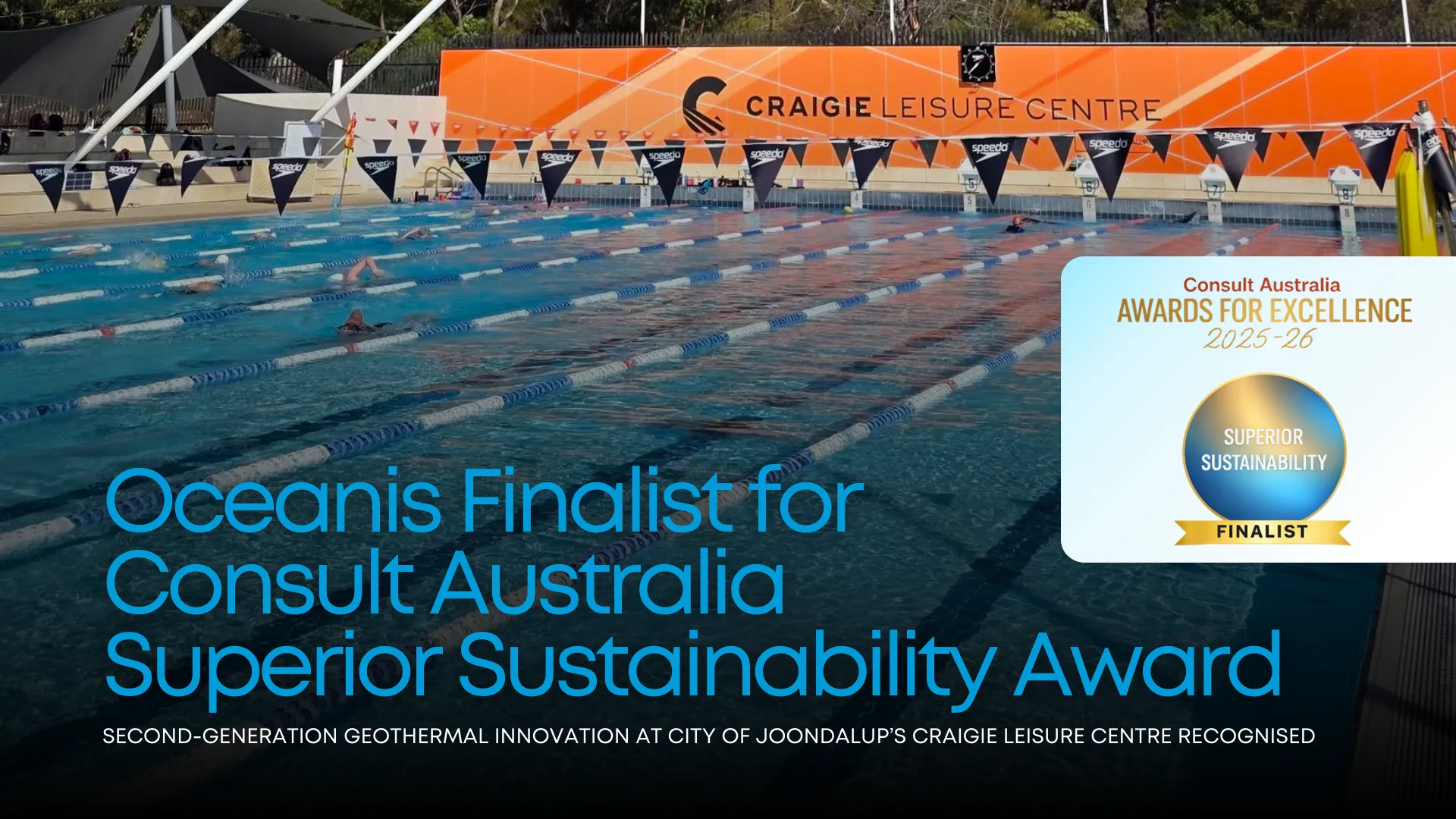
Addressing a growing challenge in public aquatic infrastructure
Early adopters of renewable energy geothermal pool heating, Western Australian local government aquatic centres had begun to experience challenges with reduced heating capacity and increasing costs.
Craigie Leisure Centre, one of Western Australia’s largest public aquatic facilities, was no exception, with reliance on electric backup heating undermining the original sustainability objectives of the system.
Through innovative second-generation geothermal heating design, Oceanis transformed the declining 20-year-old geothermal pool heating system into a high-performance renewable asset, sextupling thermal output while avoiding bore replacement and its associated embodied carbon.
A second-generation geothermal design approach
Rather than replacing the geothermal bore, Oceanis applied a second-generation geothermal design methodology that unlocked greater thermal value from the existing geothermal resource.
The rehabilitation involved a holistic re-engineering of surface infrastructure, including redesigned heat exchangers optimised for low-temperature geothermal water, cascading geothermal water use to extract multiple stages of energy, complete hydraulic reconfiguration, targeted filtration upgrades, and optimised thermal storage and control strategies.
Delivered within a live public facility and without additional bore drilling, the rehabilitated system now produces up to 1,600 kW of thermal energy, compared to approximately 250 kW prior to remediation – a more than six-fold increase in usable thermal output.

Measurable sustainability outcomes
Post-commissioning monitoring confirms sustained reductions in energy use, operating costs, and carbon emissions. The upgraded system has dramatically reduced reliance on electric backup heating, reversing nearly two decades of continuous supplementary operation.
Over a one-year period, the geothermal system achieved an estimated reduction of approximately 349 tonnes of CO₂ emissions. This reduction is equivalent to taking around 75 passenger vehicles off the road for an entire year, providing a tangible illustration of the project’s environmental impact.
Long-term value for the council and the community
The rehabilitated system is delivering annual operating cost savings exceeding $100,000, with independent assessments indicating potential savings of up to $300,000 per annum.
For the community, improved thermal reliability enhances patron comfort, supports consistent program delivery, and ensures continuity of aquatic services during peak winter periods – strengthening the performance of a major public asset relied upon by thousands of users each week.

Recognition for sustainability
The Craigie Leisure Centre geothermal rehabilitation was previously awarded the 2024 LIWA Aquatics Sustainability Award and is now recognised as a finalist in Consult Australia’s Superior Sustainability category, which celebrates projects delivering lasting environmental, economic, and social value through innovative design and application.
For Oceanis, the recognition reinforces a broader industry message and challenges the assumption that superior sustainability outcomes require new construction, and demonstrates that existing infrastructure, when approached with innovative engineering, can deliver exceptional long-term performance.